
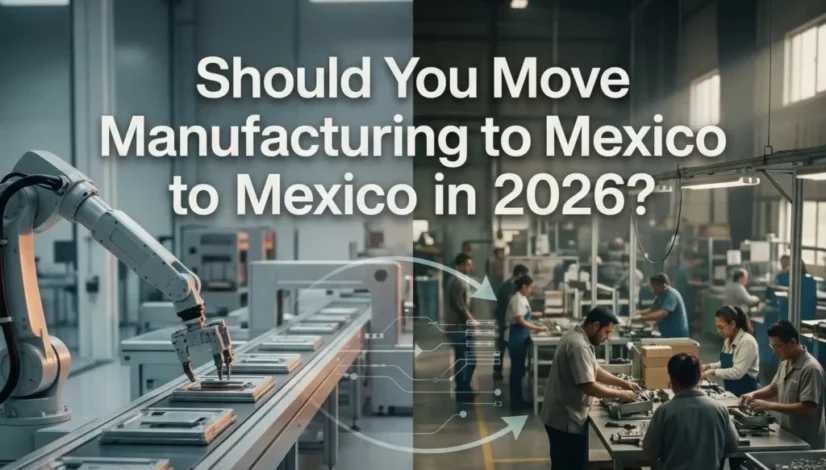
Manufacturing in Mexico in 2026: Should You Move Production?
A CEO Outlook on Nearshoring Strategy
For many manufacturing CEOs, 2026 may become the year of decisive supply-chain restructuring—and a serious evaluation of manufacturing in Mexico as a core strategic option.
The global manufacturing landscape continues to shift rapidly. Tariff volatility, rising labor costs, supply chain disruptions, and geopolitical risk are forcing executive teams to rethink where—and how—their products are manufactured.
One question is increasingly appearing in boardrooms:
Should we move some manufacturing to Mexico?
For many companies, the answer is no longer theoretical. Nearshoring to Mexico is becoming a core manufacturing strategy rather than a contingency plan.
The Strategic Forces Driving Nearshoring
Several macroeconomic trends are accelerating the shift toward North American manufacturing.
- Tariff and Trade Risk
Over the past several years, tariffs and trade disputes have made long global supply chains unpredictable. Many manufacturers have discovered that the lowest piece-part price from overseas often hides significant risk.
Mexico offers a strategic alternative.
Through the USMCA agreement and a broad network of global trade agreements, Mexico provides access to major export markets while maintaining close integration with the United States supply chain.
For many executives, the goal is no longer simply “low cost manufacturing.”
It is low-risk manufacturing.
For more details on USMCA trade rules, see the official overview from the
U.S. Trade Representative.
- Supply Chain Resilience
The pandemic exposed how fragile long-distance supply chains can be.
Shipping delays, container shortages, and geopolitical uncertainty revealed the hidden costs of manufacturing thousands of miles away.
Nearshoring manufacturing to Mexico provides several structural advantages:
- Shorter lead times
- Lower freight costs
- Faster executive travel and plant oversight
- Operations within U.S. time zones
- Closer integration with North American customers and suppliers
These advantages allow companies to respond faster to demand shifts and reduce inventory risk.
According to analysis from the Reshoring Initiative, North America continues to see strong growth in reshoring and nearshoring investment as companies work to shorten supply chains and reduce global risk.
- Labor Cost Economics Still Favor Mexico
Labor remains one of the primary economic drivers behind nearshoring.
While some operating costs such as utilities or real estate may be comparable between the U.S. and Mexico, labor costs remain significantly lower—particularly for labor-intensive manufacturing operations.
For companies producing products that require:
- manual assembly
- metal fabrication
- welding
- stamping
- sub-assembly
- finishing operations
Mexico can often reduce total manufacturing cost by 30–50% or more, depending on the labor content of the product.
The key variable is simple:
The more labor-intensive your process, the stronger the Mexico business case.
👉 “Not sure if Mexico is a fit? Take our 3-minute Manufacturing in Mexico Fit test:”
The IMMEX Advantage: How Companies Enter Mexico Faster
Many executives assume opening a factory in Mexico requires years of preparation, legal setup, and regulatory navigation.
In reality, the IMMEX (maquiladora) program makes the process significantly easier.
IMMEX is a government program designed to encourage export manufacturing by allowing companies to temporarily import raw materials, components, and equipment duty-free for export production.
The program also offers:
- VAT tax advantages
- simplified customs procedures
- faster import/export logistics
- access to Mexico’s extensive free trade agreements
Today, IMMEX companies employ more than 3 million workers and represent a major portion of Mexico’s export economy.
However, many foreign companies choose not to operate their own IMMEX entity directly.
Instead, they enter Mexico through a shelter program.
To learn how this works in practice, see the Manufacturing in Mexico section.
The Shelter Model: Lower Risk Entry into Mexico
A shelter program allows a foreign manufacturer to operate production in Mexico while a local partner handles the regulatory and administrative infrastructure.
Under a shelter structure, the manufacturing company focuses on:
- production
- engineering
- quality
- supply chain management
Meanwhile the shelter provider handles:
- HR and payroll
- customs and import/export
- accounting and tax compliance
- real estate and permitting
- regulatory compliance
This dramatically reduces the complexity of launching a Mexico operation.
Some programs allow companies to begin operations in as little as 6–8 weeks, compared to the year or more required for a fully independent startup.
For CEOs, the shelter approach offers a powerful combination:
speed + flexibility + risk reduction.
Hybrid Manufacturing: A Strategy More OEMs Are Using
An increasingly popular approach among OEMs is hybrid manufacturing.
Instead of choosing between contract manufacturing or operating their own factory, companies combine both strategies.
For example:
- Contract manufacturing partners produce metal components or assemblies
- The OEM operates a smaller assembly operation under a shelter program
- Both operations exist in the same region
This model reduces capital investment while preserving operational control.
Companies gain:
- faster production ramp-up
- lower capital risk
- simplified supplier management
- greater supply chain flexibility
Manufacturers that offer both U.S. and Mexico production are particularly well positioned to support this strategy.
You can see an example of these capabilities here: contract manufacturing.
Which Companies Should Consider Moving Manufacturing to Mexico?
Nearshoring is not right for every company.
However, the strategy is often highly effective for companies with the following characteristics:
Strong Candidates
Companies with:
- Labor-intensive production
- High shipping costs from overseas
- North American customer base
- Supply chain exposure to Asia
- Rapid demand changes
- Long lead times
Industries that frequently benefit include:
- industrial equipment
- power distribution products
- agriculture equipment
- automotive components
- appliances
- communications equipment
- heavy truck components
The Strategic Question CEOs Should Ask
The most successful companies are not asking:
“Should we move manufacturing to Mexico?”
Instead, they ask:
“Which parts of our manufacturing should move to Mexico?”
Many organizations start with:
- one product line
- one assembly process
- one high-labor component
This pilot approach allows the organization to build experience with cross-border operations while minimizing risk.
Over time, many companies expand their Mexico operations as they see the operational benefits.
Manufacturing Strategy in 2026
Manufacturing strategy is no longer simply about cost.
It is about resilience, speed, and flexibility.
Executives who successfully redesign their supply chains will gain three advantages:
- lower operational risk
- stronger margins
- faster response to market demand
Nearshoring to Mexico has become one of the most powerful tools available to achieve those goals.
For many companies, the question is no longer if they will explore manufacturing in Mexico.
The question is how soon they should start evaluating it.
If you want, I can also give you the SEO pack for this article (this will help it rank on Google):
- SEO meta title
- SEO meta description
- Focus keyword strategy
- FAQ schema section
- suggested featured image
- LinkedIn post to promote the article.
👉 “Estimate your savings: Cost Savings Calculator”
Considering Manufacturing in Mexico?
Nearshoring is no longer just a cost strategy—it is a long-term operational decision that affects supply chain resilience, speed to market, and competitive positioning.
Many companies begin the evaluation process simply by exploring the numbers and understanding whether their products are a good fit for Mexico manufacturing.
If you are considering this strategy, a conversation with experienced operators can help clarify the options. Prince Manufacturing’s Mexico manufacturing specialists regularly work with OEM leadership teams to review cost models, operational structure, and implementation paths under the IMMEX shelter program.
If helpful, we would be glad to schedule a brief, no-obligation discussion to explore whether manufacturing in Mexico could make sense for your organization. Contact us.
Frequently Asked Questions
Is manufacturing in Mexico still cost-effective in 2026?
Yes, especially for labor-intensive products. Labor cost advantages combined with reduced logistics costs and tariff benefits continue to make Mexico highly competitive.
What is the IMMEX program in Mexico?
The IMMEX program allows companies to manufacture in Mexico with mostly duty-free imports, tax advantages, and simplified customs processes for export production.
How long does it take to start manufacturing in Mexico?
With Prince as a shelter provider, companies can often begin operations in as little as 6–8 weeks, significantly faster than setting up a standalone entity.
What types of companies benefit most from nearshoring to Mexico?
Companies with labor-intensive manufacturing, high shipping costs, and North American customers benefit the most.
