
AI Is Creating a Metal Fabrication Capacity Problem
The AI infrastructure boom is moving beyond chips—and into factories
When people talk about the artificial-intelligence infrastructure boom, most of the attention goes to GPUs, servers and semiconductors.
But AI infrastructure requires something much more physical.
Every data center requires buildings, electrical distribution, power-generation equipment, cooling systems, racks, cabinets, enclosures, frames, brackets, weldments, sheet-metal assemblies and thousands of other manufactured components that have very little to do with software.
The latest data suggests that this physical side of the AI boom is accelerating rapidly.
U.S. private data-center construction reached a seasonally adjusted annual rate of approximately $85 billion in August 2026, up more than 73% from a year earlier. Associated Builders and Contractors reported that data-center construction spending increased another 7.5% in August alone and had been growing at a 149% annualized pace since March.
And that construction number measures the buildings—not the servers and racks installed inside them or the separate power-generation and transmission infrastructure required to serve them.
That makes the AI boom increasingly a metal fabrication, power infrastructure and manufacturing-capacity story.
Every Data Center Is a Physical Manufacturing Project
A data center cannot operate on processors alone.
Power has to reach the site. It has to be transformed, distributed, protected and controlled. Servers have to be housed. Heat has to be removed. Electrical equipment has to be enclosed. Mechanical equipment requires frames, supports and assemblies. Backup-power systems require generators, switchgear and associated infrastructure.
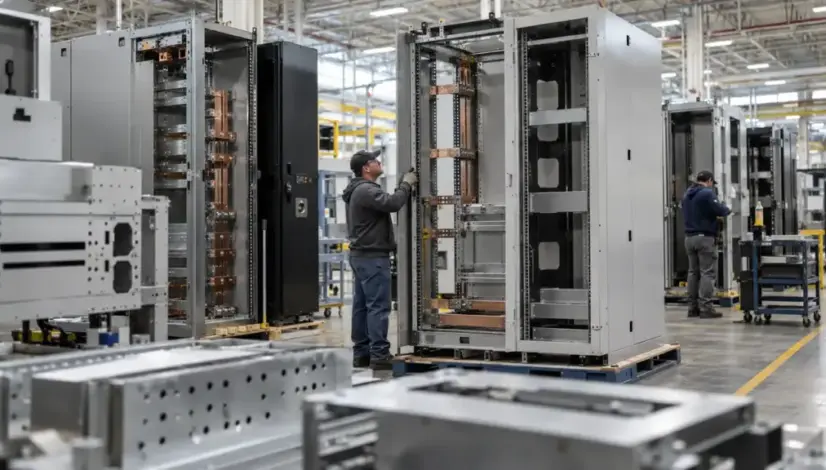
That translates into manufacturing demand for electrical cabinets and enclosures, switchgear components, power-distribution assemblies, equipment racks, busbar-related fabricated components, frames, structural parts, brackets, weldments, cooling-system components, generator enclosures, coated and painted metal products, energy-storage enclosures and mechanical assemblies.
The scale of the infrastructure expansion is substantial.
Lawrence Berkeley National Laboratory’s June 2026 update estimates that data centers could account for approximately 11.8% of total U.S. electricity consumption by 2030 in its reference case, with modeled scenarios ranging from approximately 9.5% to 15.3%.
That is not simply an electricity statistic.
It is an indication of how much generation, transmission, transformation, distribution, cooling and physical infrastructure may need to be manufactured and installed to make that computing capacity possible.
Demand Is Still Outrunning Available Data-Center Capacity
The latest data-center market numbers reinforce the scale of the buildout.
CBRE reported that capacity under construction across North America’s major primary data-center markets reached a record 7,481 MW in the first half of 2026, up 24.8% year over year.
More than 80% of that capacity was already preleased, while vacancy fell to a record-low 1.4%. CBRE estimated that less than 1,500 MW of future primary-market capacity remained available for preleasing—roughly six months of demand at the current absorption rate.
JLL, using a broader market methodology, reported approximately 66 GW under construction across North America, with 95% already committed and vacancy around 1%. It also reported a record 25 GW of absorption during the first half of 2026.
The absolute figures from CBRE and JLL should not be directly compared because their market definitions differ.
But their conclusions point in the same direction:
The industry is building enormous amounts of new capacity, and much of that capacity is being absorbed before it is finished.
That demand eventually works its way backward through the manufacturing supply chain.
Data-Center OEMs Are Seeing the Volume
A data-center developer needs more capacity.
The infrastructure OEM receives more orders.
The OEM needs additional electrical enclosures, racks, frames, fabricated components, weldments and assemblies.
Its suppliers then need more laser cutting, punching, press-brake, welding, coating and assembly capacity.
Eventually, someone has to physically manufacture the parts.
What was once largely anecdotal is now showing up in actual manufacturing investments.
In August, Texas-based All Metals Fabricating announced a second facility specifically optimized for the data-center market. The initial operation will occupy approximately 40,000 square feet, with another 100,000 square feet reserved for potential expansion.
The company said increasing numbers of data-center customers were turning to it for sheet-metal fabrication and precision machining. Its expansion plans include additional automation, powder coating and eventually capacity for large prefabricated modular data-center assemblies and weldments.
In September, Cadrex Manufacturing Solutions announced a major expansion at its Monterrey, Mexico campus.
The company added more than 20 new production machines and dedicated manufacturing capacity for data-center racks, supporting full-scale sheet-metal fabrication and high-volume production for AI and data-center infrastructure customers. The expansion is centered in a 173,000-square-foot building at the Monterrey campus.
These investments are important because they demonstrate that data-center demand is no longer affecting only the hyperscalers and equipment OEMs.
It is reaching directly into the metal-fabrication supply base.
Electrical Enclosures Are Becoming a Capacity Issue
One of the clearest examples came from Eaton in September.
Eaton announced an investment of more than $242 million in a new 1-million-square-foot manufacturing facility in North Little Rock, Arkansas.
The facility is expected to double Eaton’s U.S. manufacturing capacity for customized modular electrical enclosures from its Fibrebond business.
Eaton specifically cited growing demand from data centers, utilities, industrial customers and digital communications infrastructure as a driver of the expansion.
Think about what that means.
A major electrical manufacturer is investing nearly a quarter-billion dollars and building a million-square-foot factory partly because the market needs more electrical enclosures and modular power infrastructure.
This is no longer simply a semiconductor-capacity problem.
It is a physical manufacturing-capacity problem.
The Bottleneck Extends Far Beyond Sheet Metal
The constraint is not limited to cabinets and enclosures.
Electrical equipment, transformers, generators, cooling systems and other critical infrastructure are all experiencing strong demand.
Hitachi Energy announced in September that it will invest $528 million in a new transformer manufacturing facility in Gallman, Mississippi.
The plant will more than double the production capacity associated with Hitachi Energy’s existing Crystal Springs operation. The company said the additional capacity is needed to address rising U.S. electricity demand driven by data centers, advanced manufacturing, industrial electrification and grid modernization.
That announcement follows other major Hitachi Energy investments in transformer and grid-equipment manufacturing across the United States.
The lesson extends beyond transformers.
When AI infrastructure drives electricity demand, it also drives demand throughout the electrical system surrounding the data center.
That includes transformers, switchgear, power-distribution equipment, electrical enclosures, generators, energy storage, busway, cooling equipment and supporting structures.
Cooling Is Becoming Another Manufacturing Race
The cooling side of the data-center infrastructure market is also expanding rapidly.
On October 1, LG Electronics announced its first U.S. manufacturing facility dedicated to chillers for AI data-center cooling.
The new Virginia plant is intended to help LG respond more quickly to increasing North American demand for advanced cooling systems.
Four days later, LG announced a long-term agreement with AIR Control Concepts to provide cooling equipment supporting AI data centers representing more than 5 GW of capacity across the United States and Canada.
Then, on October 22, Carrier announced plans to invest more than $600 million in a new manufacturing and engineering operation in Fort Worth, Texas.
The facility will exceed 1 million square feet, expand commercial chiller production and create approximately 1,500 jobs. Carrier cited record backlog levels and strong demand across data centers and other major markets.
These are not isolated product announcements.
They represent hundreds of millions of dollars being committed to additional manufacturing capacity because existing and expected demand requires more equipment.
Equipment Lead Times Remain Elevated—Even as Some Categories Stabilize
The supply-chain picture requires some nuance.
Not every equipment category is becoming progressively more constrained.
In fact, SourceBlue’s Q2 2026 Cost Index reported that lead times across many mechanical and electrical equipment categories had begun to stabilize.
But stabilized does not mean short.
SourceBlue reported approximate current ranges of:
- low-voltage switchgear: 26-58 weeks;
- medium-voltage switchgear: 28-48 weeks;
- generators: 28-66 weeks;
- UPS equipment: 16-42 weeks;
- water-cooled chillers: 12-60 weeks; and
- air-handling units: 8-78 weeks.
The important point is therefore not that every lead time continues to worsen.
It is that many critical infrastructure components still require planning many months in advance, while data-center construction continues to accelerate.
That creates enormous pressure on manufacturers throughout the supply chain to increase throughput and protect production schedules.
The Bottleneck Can Move Downstream
An OEM may have enough final-assembly capacity.
But what happens when fabricated enclosures arrive late?
What if welded assemblies become the constraint?
What if the coating supplier cannot keep up?
What if a supplier produces sheet metal but cannot support assembly?
What happens when demand increases faster than the OEM can purchase equipment, find floor space, hire operators and qualify additional manufacturing processes?
The bottleneck does not always occur at the OEM’s most sophisticated operation.
Sometimes the constraint is a cabinet.
A welded frame.
A coated panel.
A power-distribution enclosure.
A group of brackets.
Or a mechanical subassembly.
Individually, these products may represent only one portion of the finished system.
Collectively, they can determine whether the finished equipment ships on time.
This Changes the Role of the Contract Manufacturer
Historically, many companies have treated metal fabrication largely as a commodity purchase.
Send out a drawing.
Get several quotes.
Select a supplier.
Repeat.
That approach works when capacity is plentiful and lead times are predictable.
A fast-growth market changes the equation.
When manufacturing capacity and delivery become strategic issues, OEMs may need suppliers capable of taking responsibility for larger portions of the manufacturing value stream.
Instead of outsourcing only one operation, an OEM can potentially outsource an integrated process:
Cut → Form → Weld → Finish → Assemble → Package → Ship
The contract manufacturer is no longer simply providing machine time.
It is providing additional manufacturing capacity and throughput.
Why Supplier Consolidation Matters During Rapid Growth
Consider a fabricated electrical enclosure moving through several suppliers.
One supplier cuts and forms the metal.
Another performs welding.
Another provides coating.
Another supplies purchased hardware.
Another completes assembly.
Each supplier change introduces another production schedule, shipment, queue, receiving step, inspection, quality handoff and communication point.
When demand is predictable and lead times are comfortable, the system may function adequately.
When volumes increase rapidly, those interfaces become more difficult to manage.
A multi-process manufacturing partner can potentially remove some of those handoffs.
That can help reduce transportation between suppliers, work in process, inventory, packaging, scheduling complexity, supplier-management workload and elapsed manufacturing time.
For infrastructure OEMs trying to increase throughput quickly, reducing the number of manufacturing interfaces can be more important than obtaining the lowest price for a single fabrication operation.
It is notable that All Metals Fabricating describes essentially the same objective in explaining its newest data-center investment: additional automation and bringing more processes under one roof are intended to increase capacity while reducing transportation and outside processing.
That is a broader manufacturing trend worth watching.
Data Centers Are Also Driving Power-Distribution Demand
The metal-fabrication opportunity extends far beyond server racks.
One of the largest physical challenges created by AI infrastructure is electrical power.
Berkeley Lab’s latest reference case projects approximately 649 terawatt-hours of U.S. data-center electricity consumption in 2030.
Serving that load requires infrastructure far upstream from the servers themselves.
Transformers have to be produced.
Switchgear has to be produced.
Electrical enclosures have to be fabricated.
Generation equipment has to be packaged.
Power-distribution systems have to be assembled.
Cooling systems have to be manufactured.
Energy-storage systems require cabinets, frames and other fabricated structures.
This means the manufacturing opportunity extends well beyond companies that describe themselves as “data-center suppliers.”
An electrical-equipment, cooling, generator or power-infrastructure manufacturer may be several tiers removed from the data-center operator and still experience significant demand generated by AI infrastructure growth.
Manufacturing Demand Is Moving Geographically Too
Another important development is where the new infrastructure is being built.
JLL reports that 77% of North American data-center capacity currently under development is now located in frontier markets.
West Texas has been a major beneficiary, but Ohio, Louisiana, Indiana and the Carolinas are also seeing significant development.
CBRE similarly reports that Atlanta overtook Northern Virginia for total capacity under construction during the first half of 2026. CBRE says power availability and infrastructure-delivery timelines have become decisive site-selection factors.
This matters to manufacturers.
As data-center development becomes geographically dispersed, the supplier base supporting it also has to become more flexible.
Manufacturing capacity may need to support projects in Texas, the Southeast, Midwest and other emerging data-center markets rather than only traditional clusters such as Northern Virginia.
Mexico Is Already Part of the Data-Center Manufacturing Supply Chain
The Cadrex expansion in Monterrey also provides another important signal.
North American data-center manufacturing is not necessarily an either-or decision between the United States and Mexico.
Cadrex’s decision to add dedicated data-center rack production, sheet-metal fabrication and automation at its Monterrey campus demonstrates that Mexico can participate directly in the North American AI infrastructure supply chain.
Different manufacturing processes can have different economic and operational requirements.
Highly automated fabrication may make sense in one location.
Labor-intensive welding, assembly, kitting or packaging may make sense in another.
For OEMs trying to increase production while reducing dependence on long international supply chains, a flexible North American manufacturing strategy can provide another capacity option.
Capacity Without Building Another Factory
The traditional response to sustained demand growth is capital investment.
Buy equipment.
Add floor space.
Add shifts.
Hire people.
Build another factory.
The investments now being made by Eaton, Hitachi Energy, Carrier, LG and others demonstrate that major OEMs are doing exactly that.
But factories take time.
Equipment has to be ordered.
Buildings have to be constructed or modified.
Labor has to be recruited and trained.
Processes have to be validated.
And an OEM must decide whether current levels of demand justify permanent fixed capacity.
Contract manufacturing provides another option.
Instead of recreating every fabrication, welding, coating and assembly process internally, an OEM can use established outside manufacturing capacity.
That can be particularly useful for overflow production, new-product launches, rapid volume increases, second sourcing, supplier consolidation, regionalization and programs in which future demand remains uncertain.
It can also allow an OEM’s internal factory to concentrate its people, floor space and capital on operations that represent the company’s core technical value.
The Bigger AI Manufacturing Story
The AI infrastructure boom is often framed as a competition for chips.
That is only part of the story.
It is becoming a competition for electricity, transformers, generators, cooling equipment, switchgear, electrical distribution, construction capacity, skilled labor, metal fabrication, finishing and assembly capacity.
The less glamorous parts of the data center may ultimately become some of the most important parts of the manufacturing schedule.
An AI server cannot operate without power.
The power equipment cannot ship without its fabricated components.
The cooling equipment cannot be completed without its frames, panels and assemblies.
And a finished system cannot leave an OEM’s factory if one enclosure, weldment, bracket or coated panel is missing.
The Bottom Line
The latest October 2026 data make the manufacturing story behind AI increasingly difficult to ignore.
Private U.S. data-center construction reached an approximately $85 billion annualized pace in August, more than 73% above the prior year. Data-center capacity under construction remains at record levels, and most of that capacity is already committed before completion.
At the same time, manufacturers throughout the supply chain are committing enormous amounts of capital to additional production.
Eaton is investing more than $242 million to double U.S. manufacturing capacity for modular electrical enclosures.
Hitachi Energy is investing $528 million in another major U.S. transformer manufacturing facility.
Carrier is committing more than $600 million to additional U.S. cooling-equipment manufacturing and engineering capacity.
LG is establishing its first U.S. AI-data-center chiller factory while entering a supply program supporting more than 5 GW of North American data-center capacity.
Metal fabricators themselves are adding dedicated data-center production capacity in both the United States and Mexico.
These investments point toward the same conclusion:
AI is creating demand far beyond semiconductors. It is creating a physical infrastructure buildout that requires enormous amounts of manufacturing capacity.
For infrastructure OEMs, the strategic question is increasingly becoming:
Do we have enough internal manufacturing capacity—and enough supplier capacity—to keep up with the opportunity?
The companies that identify those constraints before orders overwhelm their existing production systems will be in a stronger position to respond.
Need Additional Metal Fabrication and Manufacturing Capacity?
Prince Manufacturing supports OEMs that need additional North American manufacturing capacity for fabricated metal components, weldments, finished parts and assemblies.
Prince’s capabilities include metal fabrication, laser cutting, turret punching, press braking, stamping, MIG/TIG/spot welding, powder coating, E-coating, liquid and CARC painting, assembly, packaging, kitting, sequencing, labeling and shipping, with manufacturing operations in the United States and Mexico.
Prince can support individual manufacturing processes, overflow production or integrated programs that bring multiple steps of the manufacturing value stream together under one supplier relationship.
For manufacturers of data-center power distribution, electrical equipment, cooling systems, generator packages, enclosures, cabinets, frames, skids and other infrastructure, that can provide another way to increase throughput without waiting for every additional requirement to be added internally.
The objective is straightforward:
Add manufacturing capacity. Reduce supplier handoffs. Shorten the value stream. Help get more finished equipment out the door faster.
If manufacturing capacity, fabricated-metal lead times or supplier complexity are becoming constraints on your data-center infrastructure program, contact Prince Manufacturing to discuss your application or submit an RFQ.
Sources
Lawrence Berkeley National Laboratory — United States Data Center Energy Usage Report: 2025 Update
The June 2026 national study projects that U.S. data centers could consume approximately 11.8% of total U.S. electricity by 2030, with modeled scenarios ranging from 9.5% to 15.3%.
Read the Berkeley Lab report
U.S. Census Bureau — Monthly Construction Spending, August 2026, released October 1, 2026.
Associated Builders and Contractors — Data Center Construction Spending Growing at 149% Annualized Pace Since March, October 1, 2026.
CBRE — North America Data Center Trends H1 2026
CBRE reports record data-center construction of 7,481 MW across primary markets, up 24.8% year over year, with more than 80% of capacity under construction already preleased and vacancy at just 1.4%.
Read CBRE’s North America Data Center Trends report
JLL — North America Data Center Report Midyear 2026, August 2026.
Eaton — Eaton Expands Manufacturing for Modular Electrical Enclosures with $242+ Million Investment, September 2, 2026.
Cadrex Manufacturing Solutions — Data Center Rack Manufacturing Expansion in Monterrey
Cadrex expanded its Monterrey, Mexico campus with more than 20 new production machines and dedicated data-center rack manufacturing capacity. The investment provides strong real-world evidence that AI infrastructure demand is driving additional sheet-metal fabrication capacity across the North American supply chain.
Read Cadrex’s data center manufacturing expansion announcement
Hitachi Energy — Hitachi Deepens Commitment to U.S. Manufacturing with $528 Million Mississippi Transformer Factory, September 15, 2026.
LG Electronics — First U.S. Factory to Produce Chillers for AI Data Center Cooling, October 1, 2026.
LG Electronics — AI Data Center Cooling Supply Agreement Supporting More Than 5 GW, October 5, 2026.
Carrier — $600+ Million U.S. Manufacturing Expansion for Data Center Cooling
Carrier announced in October 2026 that it will invest more than $600 million in a new manufacturing and engineering facility in Fort Worth, Texas. The plant will exceed 1 million square feet and expand commercial chiller production as demand from data centers and other high-growth markets increases.
Read Carrier’s manufacturing expansion announcement
All Metals Fabricating — New Data Center Manufacturing Facility Will Improve Speed to Market, August 2026.
SourceBlue — Q2 2026 Cost Index Report, August 6, 2026.
About the Author

Marek Wawrzyniak, Nearshoring & Re-shoring Business Development Leader
Marek Wawrzyniak brings 35 years of professional experience, including 15 years focused on nearshoring and reshoring manufacturing operations to the Americas for U.S. and global companies, establishing IMMEX-compliant operations in Mexico under both NAFTA and USMCA frameworks. His career began in technology—as a software developer, IT manager, systems engineer, and entrepreneur—while expanding into manufacturing operations. He has contributed to renowned organizations, including Northwestern Mutual, Generac Power Systems, and several of the largest LATAM-based manufacturing service providers.
