
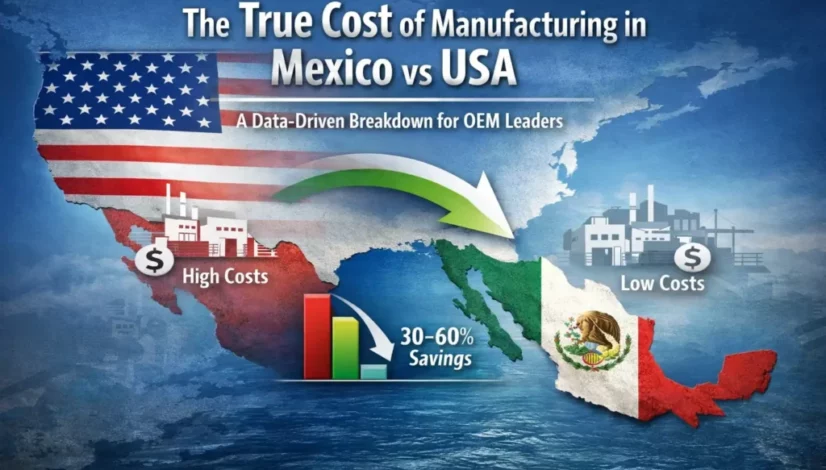
The True Cost of Manufacturing in Mexico vs USA
A Data-Driven Guide for OEMs Evaluating Nearshoring
For OEMs evaluating nearshoring, one question dominates:
How much does manufacturing in Mexico actually save compared to the United States?
Most analyses stop at wages. That’s incomplete—and often misleading.
The true cost of manufacturing includes labor, overhead, logistics, working capital, and risk. When evaluated correctly, Mexico can deliver 30–60% total cost savings, depending on your operation.
This guide breaks down the numbers, the structure, and the real-world impact.
Mexico Labor Cost vs USA Manufacturing (The Core Driver)
Labor is the single largest cost lever in the Mexico vs USA comparison.
Fully Burdened Labor Cost Comparison
Labor Cost Comparison (Fully Burdened)
Labor is the primary driver of cost savings when comparing Mexico vs USA manufacturing.
| Cost Category | United States | Mexico |
|---|---|---|
| Direct labor | $18–$30/hr | $2–$4/hr |
| Fully burdened labor | $25–$45/hr | $4–$8/hr |
| Skilled labor | $30–$50/hr | $6–$12/hr |
These figures include:
- Wages
- Benefits
- Payroll taxes
- Compliance
- Indirect labor burden
Key takeaway:
Labor—not overhead—is where Mexico delivers the majority of savings
Full Manufacturing Cost Breakdown (USA vs Mexico)
What Actually Changes—and What Doesn’t
Full Cost Structure Comparison
Not all manufacturing costs are lower in Mexico. The key advantage comes from labor and supply chain efficiency—not across-the-board cost reductions.
| Cost Component | Reality |
|---|---|
| Labor | Much lower in Mexico |
| Real estate | Often similar |
| Utilities | Comparable or slightly higher in Mexico |
| Raw materials | Global pricing (same) |
| Equipment | Same |
| Logistics | Lower vs Asia, faster vs global |
| Tariffs | Reduced under USMCA |
Insight:
Mexico is not universally cheaper—it is labor-efficient + supply-chain efficient.
Hidden Cost Savings Beyond Labor
1. Inventory & Working Capital Reduction
- Shorter supply chains
- Lower safety stock
- Reduced cash tied up in inventory
2. Lead Time Compression
- Truck vs ocean freight
- Days instead of weeks
- Faster engineering changes
Prince supports highly responsive operations, including very short lead-time programs
3. Supplier Consolidation
Integrated manufacturing reduces:
- Transport costs
- Handling
- Vendor complexity
IMMEX Program – Structural Cost Advantage
Mexico’s IMMEX (maquiladora) program is a major cost accelerator.
Key Benefits
- Duty-free imports
- VAT exemptions
- Streamlined customs
- Export incentives
Scale of Impact
- 3M+ workers in IMMEX
- ~55% of exports tied to program
Result: Lower cost + lower operational friction
Real-World Cost Comparison Example
Scenario:
- 75 employees
- Labor-intensive production
Real-World Cost Comparison Scenario
Example based on a mid-size OEM operation with labor-intensive production. Actual results vary, but this illustrates the magnitude of potential savings.
| Cost Category | USA | Mexico |
|---|---|---|
| Labor | $4.2M | $1.2M |
| Overhead | $1.5M | $1.2M |
| Logistics | $800K | $500K |
| Inventory | $900K | $500K |
| Total | $7.4M | $3.4M |
That’s approximately 54% total cost reduction, driven primarily by labor and supply chain efficiencies.
When Mexico Makes the Most Sense
Best-fit scenarios:
- Labor-intensive manufacturing
- Metal fabrication + assembly
- Multi-process production
- High mix / frequent changes
When Mexico May NOT Be Ideal
- Highly automated production
- Very low labor content
- Extremely heavy products
- Ultra-low volume runs
See if your operation is a good fit for Mexico manufacturing
Why Execution Matters More Than Location
The biggest gains come from structure, not just geography.
Prince offers:
- U.S. + Mexico operations
- Contract manufacturing + shelter
- Transparent cost models
Result:
- Lower risk
- Faster startup (6–8 weeks)
- Better cost control
Learn how the Mexico shelter program reduces risk
Estimate Your Mexico Manufacturing Savings
Reading about savings is one thing.
Seeing your numbers is another.
If your operation has meaningful labor content, the cost difference can be significant.
Try the Savings Calculator
Use it to:
- Estimate labor savings
- Identify cost drivers
- Evaluate your Mexico fit
- Mexico Labor Savings Calculator
Executive Summary
- Labor drives the majority of savings
- Total cost—not wages—determines ROI
- Nearshoring improves both cost and resilience
- Mexico is most effective for labor-intensive operations
Ultimately, the decision to move manufacturing to Mexico is not about chasing lower wages—it’s about understanding your total cost structure, operational efficiency, and long-term supply chain strategy. For the right type of operation—especially labor-intensive, multi-process manufacturing—Mexico can unlock significant advantages in cost, speed, and flexibility. However, the outcome depends heavily on how the transition is structured, modeled, and executed.
If you’re evaluating whether Mexico is the right fit for your business, our team can help you assess it with clarity. We work with OEMs to build custom cost models, evaluate labor impact, and identify the optimal manufacturing strategy—whether that’s Mexico, the U.S., or a hybrid approach.
Contact us to speak with a manufacturing expert and determine your Mexico manufacturing fit.
Explore full-service contract manufacturing capabilities
Nearshoring Trends source.
FAQ SECTION
Frequently Asked Questions
What is the average labor cost in Mexico vs USA manufacturing?
Fully burdened labor typically ranges from $25–$45/hr in the U.S. versus $4–$8/hr in Mexico, depending on skill level and industry.
How much can companies save by manufacturing in Mexico?
Most companies see 30%–60% total cost savings, driven primarily by labor and supply chain efficiencies.
Is manufacturing in Mexico cheaper for all industries?
No. It is most beneficial for labor-intensive operations. Highly automated industries may see limited savings.
What is the IMMEX program?
IMMEX is a Mexican government program that allows duty-free imports, tax advantages, and simplified operations for export-focused manufacturers.
How long does it take to start manufacturing in Mexico?
With a shelter model, operations can often begin in 6–8 weeks, depending on complexity.
About the Author

Bill Emberson, VP of Sales & Marketing
Bill Emberson brings over 25 years of sales leadership experience across the chemical, environmental, and textile sectors. He currently serves as Vice President of Sales and Marketing at Prince Manufacturing, where he leads strategic initiatives to drive growth and strengthen client relationships. Previously, he served as President, Americas at Propex Furnishing Solutions, overseeing manufacturing, sales, service, and finance operations. His career includes senior sales and account management roles at Invista and Solmax, where he developed a reputation for consultative, solution-based selling and building trusted customer relationships. Bill holds a Bachelor of Arts degree from Auburn University.
