
Data Center Equipment Manufacturing: Coatings, Finishing, and Lead-Time Risk
A CEO & Operations Perspective on Scaling Data Center Hardware Production
The global expansion of data centers—driven by AI, cloud computing, and hyperscale infrastructure—has placed unprecedented pressure on data center equipment manufacturing racks, enclosures, PDUs, and power distribution systems.
Most OEMs have responded by focusing on:
- Fabrication capacity
- Supply chain diversification
- Assembly throughput
But across the industry, a less visible constraint is quietly impacting delivery timelines:
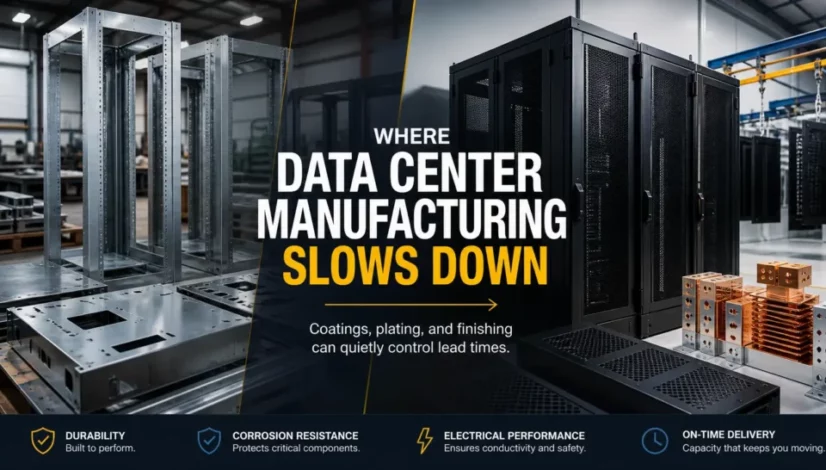
Coatings and finishing processes are becoming the hidden bottleneck in data center equipment manufacturing.
What Is Data Center Equipment Manufacturing?
Data center equipment manufacturing refers to the production of physical infrastructure used to support IT environments, including:
- Server racks and cabinets
- Server chassis and enclosures
- Power Distribution Units (PDUs)
- Cable trays and routing systems
- Copper and aluminum busbars
These components must meet strict requirements for:
- Structural integrity
- Electrical performance
- Thermal management
- Corrosion resistance
- Visual consistency
Why Coatings and Finishing Matter More Than Ever
In modern data center environments, coatings are not cosmetic—they are functional and critical.
Key coating applications include:
- Powder coating for durability and corrosion resistance (racks, enclosures)
- Electroplating for conductivity and grounding (busbars, electrical components)
- Fluidized coating for insulation and wear resistance (power components)
As product complexity increases, many components now require multi-stage finishing processes, which significantly impacts throughput.
Where Manufacturing Starts to Break Down
Let’s break this down by product category:
- Server Racks & Cabinets
- Require consistent cosmetic finish across large surfaces
- High-volume, repeatable SKUs with variations
- Powder coating lines often become saturated during scale-up
Result: Lead times stretch despite fabrication being on schedule
- Power Distribution Units (PDUs)
- Require precision metal housings + conductive plating
- Tight tolerances and compliance requirements
- Often involve multiple finishing processes
Result: Bottlenecks occur between fabrication and final assembly
- Busbars (Copper & Aluminum)
- Require plating or insulation coatings
- Sensitive to handling, defects, and consistency
- Often outsourced to specialized suppliers
Result: Supplier dependency creates risk and delays
The Hidden Bottleneck: Why Coating Capacity Becomes the Constraint
Most manufacturers scale fabrication first.
But coating capacity is fundamentally different:
Fabrication is scalable:
- Add machines
- Add shifts
- Add labor
Coating is constrained:
- Limited line capacity
- Batch processing limitations
- Setup time between finishes
- Environmental and compliance restrictions
The real issue:
Coating is rarely the first problem—but it is often the one that delays shipments.
Signs You May Already Be Experiencing This Bottleneck
Many OEMs don’t recognize the issue until it impacts delivery.
Watch for these indicators:
- Increasing lead times despite stable fabrication output
- Over-reliance on a single coating supplier
- Delays between fabrication and assembly
- Quality inconsistencies or rework
- Difficulty scaling mixed product lines
What Leading Data Center OEMs Are Doing Differently
Forward-thinking manufacturers are proactively addressing this risk.
- Adding Parallel Coating Capacity
Not replacing suppliers—but adding backup or overflow capacity
- Integrating Finishing with Fabrication
Reducing handoffs between vendors
- Nearshoring Production
Leveraging U.S. and Mexico operations to improve:
- Lead times
- Cost structure
- Supply chain resilience
- Planning for Coating Early in Product Lifecycle
Designing with manufacturability and finishing in mind
Why Coating Strategy Impacts More Than Just Production
Coating and finishing directly affect:
Lead Time
Delays in finishing delay the entire shipment
Cost
Expedited coatings, rework, and inefficiencies increase cost
Quality
Inconsistent finishes lead to:
- Customer dissatisfaction
- Rejections
- Brand impact
Scalability
Without coating capacity, growth stalls—even if demand is strong
Example: A Common Scenario
A data center enclosure manufacturer experienced:
- 4–6 week fabrication lead times
- But 8–10 week coating delays
The issue wasn’t production—it was finishing capacity.
By adding a secondary coating partner and integrating fabrication + finishing:
- Lead times dropped significantly
- Risk was reduced
- Production became predictable
Self-Assessment: Are You at Risk of Coating Bottlenecks?
Ask yourself:
- Do you rely on a single coating or plating supplier?
- Are your coating lead times increasing?
- Do you run multiple finishing processes on the same components?
- Are delays occurring between fabrication and assembly?
- Do you lack backup capacity for peak demand?
If you answered “yes” to 2 or more, coating may already be a constraint in your operation.
How Prince Manufacturing Supports Data Center Equipment OEMs
Prince Manufacturing works with data center equipment manufacturers to address exactly these challenges.
Capabilities include:
- Powder coating for racks, cabinets, and enclosures
- Plating for conductive components
- Fluidized coating for insulation and durability
- Integrated metal fabrication and assembly (as needed)
Operations across the U.S. and Mexico provide:
- Flexible capacity
- Nearshoring advantages
- Reduced lead-time risk
In many cases, Prince is brought in not to replace existing suppliers—but to:
- Provide overflow capacity
- Act as a secondary source
- Stabilize production during growth
Not Sure Where Coating May Become a Constraint?
Many data center equipment manufacturers don’t identify coating bottlenecks until they impact delivery schedules.
We can help you evaluate this—quickly and practically.
Get a Free Coating & Manufacturing Fit Assessment
In a short session, we’ll help you:
- Identify potential coating capacity risks
- Benchmark your current setup
- Explore options for backup or overflow support
- Evaluate U.S. vs Mexico production scenarios
No obligation. No generic recommendations—only practical insights.
Let us know using our CONTACT form.
Final Thought
As demand for data center infrastructure continues to accelerate, manufacturers that proactively address coating and finishing constraints will be best positioned to scale efficiently, protect margins, and meet customer expectations.
Those that don’t may find that the real limitation isn’t fabrication—but what happens after.
About the Author

Bill Emberson, VP of Sales & Marketing
Bill Emberson brings over 25 years of sales leadership experience across the chemical, environmental, and textile sectors. He currently serves as Vice President of Sales and Marketing at Prince Manufacturing, where he leads strategic initiatives to drive growth and strengthen client relationships. Previously, he served as President, Americas at Propex Furnishing Solutions, overseeing manufacturing, sales, service, and finance operations. His career includes senior sales and account management roles at Invista and Solmax, where he developed a reputation for consultative, solution-based selling and building trusted customer relationships. Bill holds a Bachelor of Arts degree from Auburn University.
