
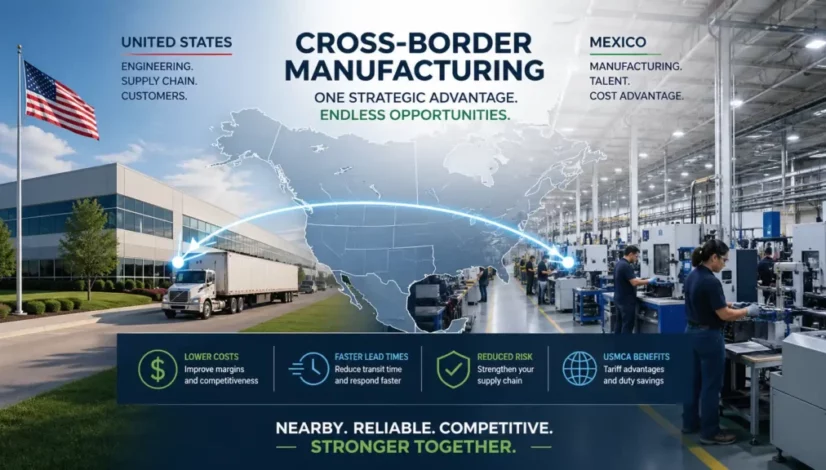
Mexico’s IMMEX Shelter Program: A Strategic Guide How it Works
A Strategic Guide for Executives Evaluating Manufacturing in Mexico
Intorduction
What is the IMMEX shelter program?
The IMMEX shelter program allows foreign companies to manufacture in Mexico under a third-party legal entity while benefiting from tax and tariff advantages. The shelter provider holds the IMMEX registration and manages compliance, HR, and administration, while the customer retains full control over production, engineering, and quality.
How does shelter manufacturing in Mexico work?
Shelter manufacturing in Mexico works by dividing responsibilities: the foreign company controls operations (production, quality, supply chain), while the shelter provider handles all legal, administrative, and regulatory functions. This structure enables companies to launch quickly, reduce risk, and operate in Mexico without establishing their own legal entity.
What are the benefits of the IMMEX program for U.S. manufacturers?
The IMMEX program allows U.S. manufacturers to temporarily import raw materials into Mexico duty-free, manufacture or assemble products, and export them back—often tariff-free under USMCA. This results in lower production costs, reduced tariff exposure, faster lead times, and improved supply chain flexibility.
Executive Overview
Manufacturing strategy is undergoing a structural shift. What was once driven primarily by labor arbitrage is now shaped by:
- Tariff exposure
- Supply chain resilience
- Lead time compression
- Labor availability
- Working capital efficiency
Mexico has emerged as a central solution—not simply as a low-cost alternative, but as a strategic North American manufacturing platform.
At the center of this shift is the IMMEX program, particularly when deployed through a shelter structure, which enables companies to:
- Enter Mexico quickly
- Minimize legal and financial risk
- Maintain operational control
- Improve cost and supply chain performance
Key takeaway: For many OEMs and Tier suppliers, the IMMEX shelter model represents the fastest and lowest-risk path to nearshoring.
What Is the IMMEX Program?
The IMMEX program (Industria Manufacturera, Maquiladora y de Servicios de Exportación) is a Mexican government initiative designed to support export-oriented manufacturing.
How It Works:
- Raw materials and components are temporarily imported into Mexico duty-free
- These inputs are processed, assembled, or manufactured
- Finished goods are exported (primarily to the U.S.)
Key Benefits:
- Duty-free importation of materials and equipment
- VAT exemptions and preferential tax treatment
- Streamlined customs processes
- Access to skilled labor
Scale and Impact:
- Over 3 million workers employed
- Represents approximately 35% of Mexico’s manufacturing employment
- Drives roughly 55.8% of Mexico’s exports
IMMEX is not a niche incentive—it is a core pillar of Mexico’s industrial economy.
What Is a Shelter Program (and How It Connects to IMMEX)?
A shelter program is the operational model that enables foreign companies to use IMMEX without setting up a legal entity in Mexico.
Relationship Between IMMEX and Shelter:
- IMMEX = Government program that provides tax and trade advantages
- Shelter = Business structure that allows you to operate under an existing IMMEX entity
How It Works:
The shelter provider:
- Holds the IMMEX registration
- Acts as the legal entity in Mexico
- Manages compliance, HR, payroll, customs, and administration
The customer:
- Controls production, engineering, and quality
- Retains ownership of intellectual property
- Operates under U.S.-based contracts
This structure allows companies to:
- Operate in Mexico without legal or fiscal presence
- Avoid regulatory complexity
- Launch faster and with lower risk
Shelter vs Standalone Manufacturing
| Factor | Shelter Model | Standalone Operation |
| Time to Launch | 6–8 weeks | 12–24 months |
| Legal Risk | Low | High |
| Capex | Minimal | High |
| Compliance Burden | Managed by provider | Fully internal |
| HR & Payroll | Included | Must build internally |
| Control | High (operations) | Full |
| Risk Exposure | Low | High |
Insight: Shelter provides most of the operational control with significantly reduced risk and time-to-market.
Shelter vs Joint Venture (JV)
| Factor | Shelter | JV |
| Ownership | Operational control retained | Shared |
| IP Risk | Low | Elevated |
| Governance | Simple | Complex |
| Exit Flexibility | High | Limited |
| Long-Term Stability | High | Often unstable |
Joint ventures frequently fail due to misaligned incentives and governance challenges. Shelter avoids these structural risks.
Should You Move Manufacturing to Mexico?
A structured decision framework is essential.
You should strongly consider Mexico if your operation includes:
- High labor content
- Complex assemblies
- Long lead times from Asia
- Tariff exposure
- Supply chain instability
For a deeper executive perspective, see: Should You Move Production to Mexico?
Strong Fit Examples (but not only):
- Metal fabrication and assemblies
- Electrical enclosures and busbars
- Industrial equipment components
- Multi-process manufacturing
Mexico Manufacturing Myths (Updated)
Myth 1: “Mexico cannot support advanced manufacturing”
Reality: Mexico supports aerospace, automotive, electronics, and high-precision industrial manufacturing at global standards.
Myth 2: “You lose control in a shelter model”
Reality: You retain full control over production, engineering, and quality. The shelter provider only manages administrative and regulatory functions.
Myth 3: “Savings come from everything being cheaper”
Reality: Labor is the primary driver of savings. Real estate, utilities, and other costs are often similar to the U.S.
Myth 4: “Mexico is low-skill only”
Reality: Mexico supports advanced manufacturing across aerospace, automotive, and electronics
Myth 5: “Quality is lower”
Reality: ISO, TS, and TACOM-certified operations are standard
Myth 6: “Security risk outweighs benefits”
Reality: Industrial zones are highly secure and widely used by Fortune 500 companies
Myth 7: “Only for automotive”
Reality: Growth sectors include:
- Data centers
- Power distribution
- Industrial equipment
- AgTech
Tariffs, Trade, and Cost Implications
IMMEX Tariff Advantage:
- Temporary imports → duty-free
- Exported goods → often duty-free under USMCA
Key Considerations:
- Tariffs apply if goods enter Mexican domestic market
- Must maintain strict export compliance
- Documentation and tracking are critical
Practical Example:
TARIFF MATH EXAMPLE
Scenario: A U.S. company assembles industrial control panels using electronic components (25% U.S. tariff if sourced directly from China).
Option A — Source from China directly:
25% tariff on $500K/year in components = $125K annual tariff exposure.
Option B — IMMEX shelter in Mexico:
Components imported to Mexico (no Mexican duty), assembled into finished panels, exported to U.S. under USMCA.
Tariff on finished panels: 0%.
Annual tariff savings: ~$125K+
Plus additional savings from labor arbitrage and improved supply chain positioning.
Strategic Outcome:
- Eliminate or reduce tariffs
- Improve cost predictability
- Increase margin
- Maintain flexibility in sourcing
How USMCA Benefits IMMEX
USMCA strengthens IMMEX by:
- Allowing duty-free trade within North America
- Incentivizing regional sourcing
- Supporting rules-of-origin compliance
Result: This enables companies to transition from offshore supply chains to North American manufacturing ecosystems.
Raw Materials (Steel, Aluminum, etc.)
Key sourcing strategies include:
- Importing materials under IMMEX (duty-free)
- Sourcing locally in Mexico
- Hybrid sourcing across regions
Important considerations:
- Tariffs depend on origin and compliance
- Many companies use U.S. materials, process in Mexico, and re-import under optimized structures
Strategic Advantage:
Flexibility in sourcing = cost control + risk mitigation
Why Companies Are Moving from Asia to Mexico
Primary drivers include:
Lead Time Reduction
- Asia: 8–16+ weeks
- Mexico: Days to weeks
Freight Optimization
- Reduced reliance on ocean shipping
- Lower variability
Working Capital Efficiency
- Lower inventory requirements
- Faster cash cycles
Risk Reduction
- Reduced geopolitical exposure
- More predictable operations
Industry Use Cases & Success Stories
Example 1: Automotive Supplier Nearshoring Shift
A Tier 1 automotive supplier relocated sub-assembly production from Asia to Mexico under an IMMEX structure.
Results:
- Reduced lead time from 12 weeks to under 3 weeks
- Lowered landed cost by over 30%
- Improved responsiveness to OEM demand fluctuations
Example 2: Agricultural Robotics (Solinftec)
- Full product manufacturing outsourced
- Rapid scaling achieved
- Reduced time-to-market
Example 3: Industrial Equipment Manufacturer
A U.S.-based manufacturer moved fabrication and assembly operations to Mexico.
Results:
- Consolidated multiple suppliers into one integrated operation
- Reduced logistics complexity
- Improved delivery consistency
Risks and What to Watch Out For
Key risks include:
- Selecting an inexperienced shelter provider
- Inaccurate cost modeling
- Underestimating supply chain adjustments
- Compliance gaps
Critical insight: Execution partner and quality determine success more than strategy alone.
Diagnostic: Should You Consider IMMEX?
Evaluate your operation:
| Factor | Low | Medium | High |
| Labor intensity | ☐ | ☐ | ☐ |
| Tariff exposure | ☐ | ☐ | ☐ |
| Lead time pressure | ☐ | ☐ | ☐ |
| Product complexity | ☐ | ☐ | ☐ |
| Volume stability | ☐ | ☐ | ☐ |
If three or more factors are high, Mexico is likely a strong fit.
Conclusion: Strategic Takeaways
IMMEX shelter is most effective when:
- Speed and risk reduction are priorities
- Internal Mexico expertise is limited
- Flexibility is required
It is less effective when:
- Labor content is minimal
- Operations are fully automated
- Supply chain pressures are low
Invitation
If you are evaluating your manufacturing strategy:
- Assess your cost structure
- Evaluate supply chain risk
- Compare regional manufacturing options
A practical next step is to complete a Mexico Manufacturing Fit Assessment and review a customized cost model.
Next Step: Evaluate Your Opportunity
If you are considering manufacturing in Mexico, the fastest way to move forward is to evaluate your specific situation.
You can start with these short, practical tools:
- Mexico Manufacturing Fit Test
(3-minute assessment to see if Mexico is a strong fit) - Shelter Cost Calculator
(Estimate potential cost savings and operating structure) - Tariff Lookup Tool (Optional)
(Understand your current and future tariff exposure)
You can request a private working session with a Prince manufacturing expert.
In this session, we will:
- Review your assessment results
- Walk through a high-level cost model
- Identify the best structure (shelter, contract, or hybrid)
- Outline a practical path to implementation
This is not a sales call—it is a working session designed to give you clarity on whether IMMEX makes sense for your operation.
