
Industrial Liquid Paint for Metal Parts: A 2026 Guide for OEMs
Why industrial liquid paint still matters
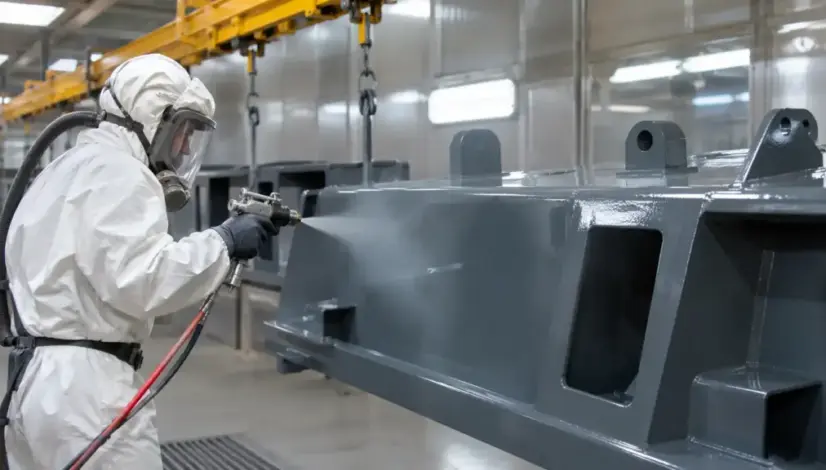
Industrial liquid paint has changed considerably since Prince Manufacturing first published its article on the advantages of liquid coating roughly nine years ago. The fundamental idea remains sound: no single finishing technology is best for every manufactured part. Material, geometry, corrosion exposure, appearance, cure limits, masking, production volume, specifications and downstream assembly requirements should determine the coating system. Prince’s original article correctly emphasized flexibility, color choice, masking and surface appearance as reasons liquid coatings remain relevant. [2]
What has changed is the technology surrounding those coatings.
Modern industrial liquid finishing now includes sophisticated two-component epoxies and polyurethanes, high-solids formulations, increasingly capable waterborne systems, electronic plural-component proportioning, electrostatic application, automated spray control and robotic finishing. Current commercial portfolios include solventborne and waterborne epoxies, acrylics, urethanes and other resin systems designed for OEM metal applications. [3]
That makes “wet paint” an overly simple description. Industrial liquid coating today is better understood as a designed coating system consisting of substrate preparation, pretreatment, primer, topcoat, application method, film thickness and cure conditions selected for the product’s actual service environment.
For OEMs producing electrical equipment, fabricated weldments, heavy trucks, agricultural machinery, defense equipment or industrial machinery, this distinction matters. A coating decision can affect corrosion resistance, appearance, assembly, rework, environmental compliance and the number of suppliers involved in moving a finished product from fabricated steel to the production line.
Where liquid coatings provide the strongest fit
Liquid coatings remain particularly useful when manufacturers need flexibility in chemistry, finish, film build, masking or cure requirements.
Epoxy primers and coatings are widely used where adhesion, chemical resistance and corrosion protection are priorities. Modern options include both solventborne and waterborne two-component systems. For example, Sherwin-Williams currently markets a two-component water-reducible epoxy primer for metal that can be applied through conventional, HVLP, air-assisted airless and airless systems. [4]
Polyurethane topcoats are common where exterior weathering, color retention and finish quality are important. Current high-solids two-component polyurethane systems are designed for applications including heavy-duty vehicles, machinery and enclosures and can be applied using conventional and air-assisted spray processes. [5]
Waterborne coatings have become materially more capable than they were a generation ago. Manufacturers now offer waterborne primers and topcoats for transportation, power-generation and general industrial applications, allowing finishers to reduce reliance on traditional solvent-heavy formulations where product specifications permit. [6]
High-solids coatings are another important development. Increasing the proportion of coating solids can reduce the amount of solvent associated with applying a required dry film, although actual VOC performance depends on the specific formulation and applicable regulatory definition. EPA recognizes waterborne and high-solids technologies among the approaches used to reduce VOC/HAP emissions from coating operations. [7]
A simplified decision framework is:
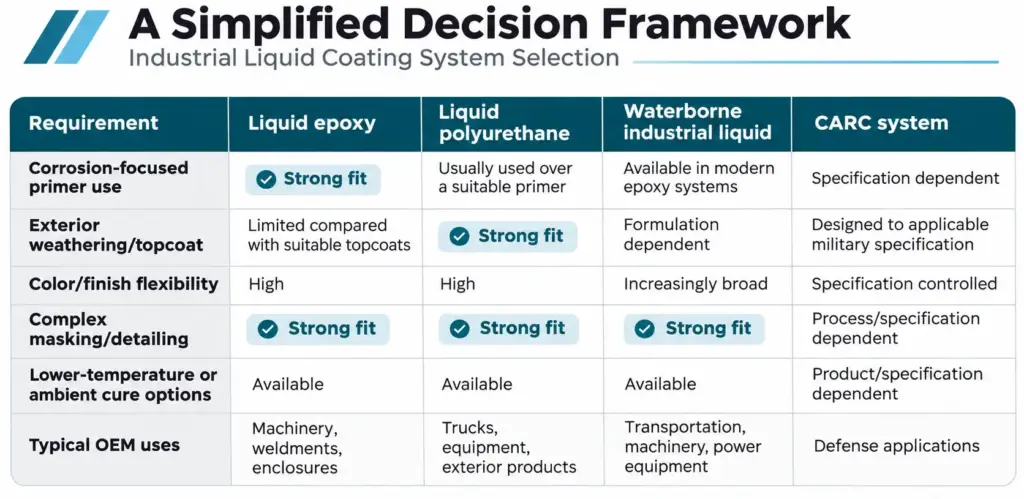
This table is a selection guide, not a performance ranking. Final coating chemistry should be chosen against the OEM specification, substrate, environment and coating manufacturer’s technical data.
Surface preparation is where coating performance begins
A premium coating applied over an improperly prepared surface is still an improperly prepared coating system.
AMPP’s surface-preparation standards address contamination removal, blast-cleaning levels, soluble salts and surface profile because adhesion and coating performance depend heavily on substrate condition. Relevant standards include SSPC-SP 1 solvent cleaning, SSPC-SP 6/NACE No. 3 commercial blast cleaning and SSPC-SP 10/NACE No. 2 near-white metal blast cleaning, among others. [8]
For appropriate steel applications, zinc-phosphate conversion pretreatment remains an established process before painting. Henkel describes zinc phosphating as a spray- or immersion-applied metal pretreatment that creates a foundation intended to improve paint adhesion and corrosion protection. [9]
A multi-stage process may include cleaning, rinsing, conditioning, phosphating and subsequent rinsing or sealing steps. The exact chemistry and stage sequence matter, so buyers should avoid assuming that every process described simply as “phosphate wash” is equivalent.
At Prince Manufacturing’s Garrett, Indiana facility, the published process includes a seven-stage zinc-phosphate pretreatment line as part of the overhead liquid-paint operation. Prince also lists TACOM-approved wash-and-rinse pretreatment availability. [10]
Quality verification should also be tied to the specification rather than vague claims such as “industrial grade.” ASTM D7091 covers nondestructive dry-film-thickness measurement on coated metallic substrates, while ASTM D3359 provides methods for assessing coating adhesion by tape testing. [11]
Depending on the program, an OEM may also specify corrosion exposure testing, hardness, abrasion, gloss, color, cure verification or other validation methods. Prince lists coating-thickness, adhesion, salt-spray, color, abrasion and hardness verification equipment among its finishing-related capabilities. [12]
What has changed in liquid-paint technology
One of the most important developments of the last decade is not a new paint chemistry at all. It is better control of the coating process.
Two-component, or 2K, coatings depend on the correct proportion of resin and catalyst. Electronic plural-component systems can meter components at controlled ratios, manage multiple colors and catalysts, store operating parameters and generate process data. Graco’s current industrial equipment, for example, supports electronic proportioning, automatic or manual configurations and web-based process management. [13]
This matters because coating quality depends on more than what comes out of the paint can. Mix ratio, pot life, viscosity, atomization, film thickness, flash time and cure all affect the finished result.
Electrostatic liquid spraying also continues to improve material utilization on suitable conductive parts. Charged coating droplets are attracted toward a grounded workpiece, which can increase deposition and provide useful wraparound on appropriate geometries. Actual transfer efficiency varies greatly with coating, part shape, grounding, booth conditions and operator or robot setup; equipment manufacturers specifically emphasize these variables rather than treating electrostatics as a universal efficiency guarantee. [14]
Automation and robotics are becoming more accessible for industrial finishing. Automatic trigger control, robot-mounted applicators, programmable recipes and electronic metering can improve repeatability and reduce dependence on manual adjustment in suitable production environments. Current systems can integrate automatic guns and proportioners with robots, reciprocators and plant controls. [15]
The important distinction for buyers is that these are industry technology trends. They should not be interpreted as Prince Garrett capabilities unless Prince specifically publishes or confirms that a particular technology is installed there.
Environmental and worker-safety requirements have also become a larger part of coating strategy. EPA regulates surface-coating operations through several Clean Air Act programs, including requirements affecting miscellaneous metal parts and products, while OSHA standards address spray-finishing operations using flammable and combustible materials and requirements applicable to dual-component coatings. [16]
For purchasing teams, the implication is straightforward: coating selection should evaluate not only price and finish performance, but also the coater’s process control, documentation, ventilation, handling practices and ability to work with compliant coating systems.
How OEMs should choose an industrial liquid-paint supplier
A good sourcing process starts with the part rather than the painter.
Give prospective coating suppliers the substrate, part dimensions and weight, annual volume, drawing, masking requirements, appearance criteria, target dry-film thickness, corrosion or environmental requirements, coating specification, packaging requirements and expected delivery pattern.
Then evaluate the supplier against five practical questions.
Can the supplier prepare the substrate correctly? Cleaning, blast preparation and conversion coating can be as important as the topcoat. Ask for the actual pretreatment sequence and controls rather than simply asking whether the supplier “does phosphate.”
Can the process handle the part geometry and weight? Conveyor clearances, hanger loading, booth dimensions and orientation can determine feasibility before coating chemistry enters the discussion.
Can the supplier document the coating process? OEM programs increasingly benefit from controlled specifications, inspection records and repeatable process parameters. Film thickness, adhesion and cure requirements should be clear before launch. ASTM D7091 specifically notes that many industrial coating specifications establish minimum and maximum dry-film thickness requirements. [17]
Can upstream manufacturing be combined with finishing? For fabricated products, it may be more valuable to evaluate the complete flow of laser cutting, forming, welding, finishing, assembly and logistics than to optimize paint price alone. Prince’s published fabrication capabilities include cutting, forming, welding, machining and assembly in addition to coating services. [18]
That is a total-landed-cost issue. Each additional supplier can introduce transportation, queues, handling, packaging, scheduling interfaces and another quality handoff. The economic question therefore is not only, “What does painting cost?” but, “What does it cost to deliver a conforming finished assembly to our line?”
Can the supplier support the applicable specification? This is particularly important in defense programs. CARC is not simply a generic olive-drab paint. The coating system must follow the applicable military requirements. Prince lists MIL-DTL-53072 CARC systems, TT-C-490 pretreatment options, specified primers and CARC topcoats among its current military finishing capabilities. [19]
At Garrett, Prince’s published liquid-paint operation includes an 1,800-foot overhead monorail, seven-stage zinc-phosphate pretreatment, three sets of paint booths, CARC capability, a 500-pound overhead capacity and a 12-foot maximum part length. The Garrett facility’s current ISO 9001:2015 certificate covers assembly and coating for automotive and nonautomotive industries and is valid through July 24, 2027. [20]
For OEMs sourcing fabricated and painted metal assemblies, Prince can therefore be evaluated not simply as a paint source but as a potential fabricate → weld → finish → assemble partner.
Call to action: If you are evaluating an industrial liquid-paint program, send Prince Manufacturing a drawing, substrate, annual volume and coating specification. The Garrett team can review part fit, pretreatment requirements, coating options and whether integrating fabrication or welding with liquid finishing could simplify the sourcing flow.
Frequently asked questions
What is industrial liquid paint?
Industrial liquid paint is a coating applied in liquid form to a manufactured substrate and subsequently dried or chemically cured. Systems can include primers, intermediate coats and topcoats using chemistries such as epoxy, polyurethane, acrylic and other resin families. Modern liquid coatings include solventborne, waterborne and high-solids formulations. [21]
When is liquid paint better than powder coating?
Neither process is universally better. Liquid paint can be attractive when an OEM needs broad chemistry choices, detailed masking, specific appearance characteristics, field-repair compatibility or cure conditions that are difficult for a particular powder process. Powder may be preferable in other applications. The decision should be based on the product specification and service environment rather than a general ranking. Prince’s original discussion of liquid coating similarly emphasized that the correct process depends on the part and application. [2]
What does zinc-phosphate pretreatment do before painting?
Zinc phosphating creates a conversion layer on appropriate metal surfaces that provides a foundation for subsequent paint adhesion and corrosion protection. Cleaning and process control remain essential; zinc phosphate is one component of the complete coating system rather than a substitute for correct surface preparation. [9]
What are 2K industrial coatings?
A two-component, or 2K, coating combines separate components—commonly a resin and catalyst or hardener—at a specified ratio before application. Electronic proportioning systems are increasingly used to control that ratio and manage process parameters. [22]
How is industrial paint thickness checked?
Dry-film thickness can be measured nondestructively using magnetic or eddy-current gauges where appropriate. ASTM D7091 describes procedures for calibration, verification, adjustment and measurement on ferrous and nonferrous metallic substrates. [17]
Can liquid coatings have lower VOC content than traditional solventborne paint?
Yes. Waterborne and high-solids coatings are among the technologies used to reduce VOC emissions, although the actual VOC content and regulatory status depend on the specific formulation and applicable rules. EPA identifies waterborne and high-solids coatings as lower-emitting approaches used in surface-coating operations. [7]
Does Prince Manufacturing offer CARC liquid coating in Garrett, Indiana?
Yes. Prince’s current Garrett capability page lists CARC coating and TACOM-approved pretreatment availability, and Prince’s certifications page identifies applicable CARC system, pretreatment, primer and coating specifications. Individual programs still require review against the customer’s drawing and governing specification. [1]
https://princemanufacturing.com/prince-manufacturing-garrett-in-capabilities
[2] Choosing a Coating: Liquid Paint Advantages – Prince Manufacturing
[4] [6] Kem Aqua® 90P Water Reducible Epoxy Primer | Sherwin-Williams
[5] Spectracron® SPU9000 BHS Gen 2
[7] Monitoring by Control Technique – Compliant (Low/No VOC/HAP) Inks and Coatings
[8] Standards Committee – SC 05 Surface Preparation – AMPP
[9] Zinc phosphate coatings – Henkel Adhesives | Henkel Adhesives
[11] [17] Standard Practice for Nondestructive Measurement of Dry Film Thickness of Nonmagnetic Coatings Applied to Ferrous Metals and Nonmagnetic, Nonconductive Coatings Applied to Non-Ferrous Metals
[12] [18] Manufacturing Equipment List – Prince Manufacturing
[13] [22] ProMix 2KS Plural Component Mixing Systems
[14] How Electrostatic Spray Guns Can Benefit Your Facility
[15] Paint Automation – Robotic Paint Systems
[16] [23] Surface Coating of Miscellaneous Metal Parts and Products: National Emission Standards for Hazardous Air Pollutants (NESHAP)
[19] Outsourcing CARC Painting – Prince Manufacturing
